Home / Article
Cold Chain Controllers Belong Inside the CMMC Scope
A joint advisory dated November 5, 2026 warns about refrigeration controllers. The Cybersecurity and Infrastructure Security Agency (CISA) signed it. The Federal Bureau of Investigation (FBI) signed it too. The Department of Health and Human Services (HHS) joined them. The Department of Agriculture (USDA) and the Department of Transportation (DoT) joined too. The Internet Crime Complaint Center (IC3) published the advisory.
The warning is simple. Attackers target electronic temperature controllers. They target commercial refrigeration controllers in grocery and cold storage sites. These are operational technology (OT) devices. They sit on the shop floor, not in the server room. That is why teams miss them.
The advisory names three ways in. The first is authentication bypass. The second is arbitrary code injection. The third is weak configurations. A controller on the public internet is an open door. A default password is an open door. The advisory names no vendor. It gives no victim counts. It attributes the activity to no group and no country.
Reporting adds context the advisory does not give. Reuters, via TechCrunch and BleepingComputer, reported an October 12 wave that hit an estimated 250 to 350 French supermarkets. Attackers remotely activated defrost and raised temperatures. A second wave in early November affected more than 115 stores across six European countries. Some units reached 50 degrees Celsius. These numbers come from reporting, not from the advisory.
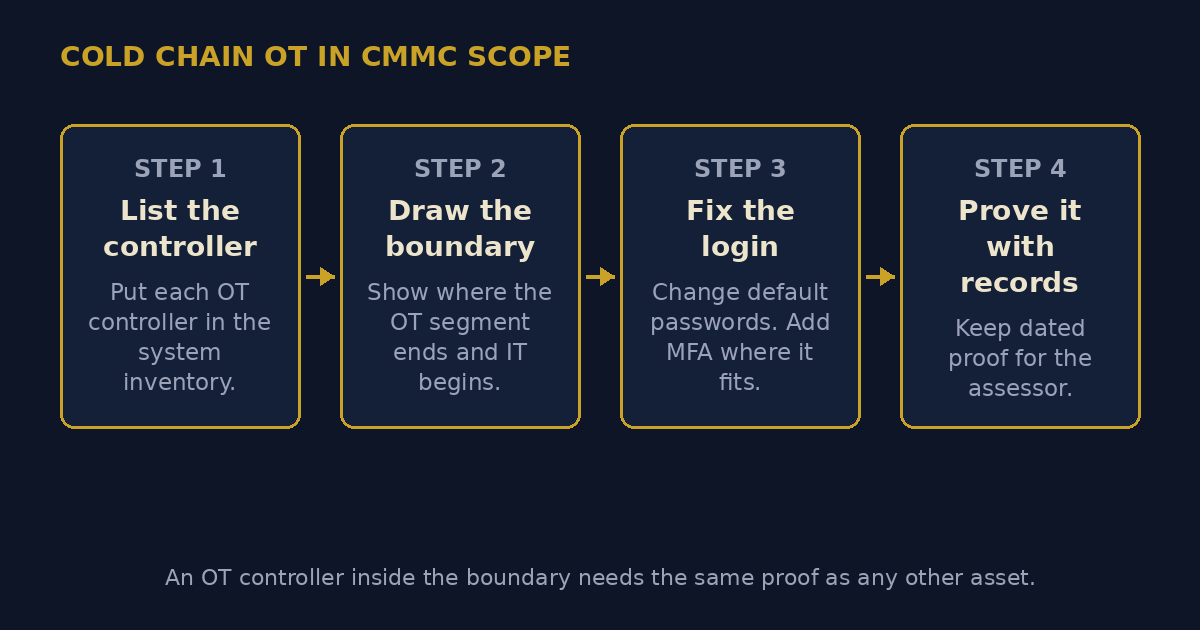
For a CMMC assessment, the lesson is scope. An OT controller inside the facility is inside the authorization boundary when it connects to the network. It belongs in the system inventory. It needs a recorded owner, a firmware version, and a location. It needs the same login rules as any other asset. Default credentials fail that test. An unlisted controller is a gap an assessor will find.
The advisory lists the fixes. Remove public internet exposure. Isolate OT devices on a dedicated virtual local area network (VLAN). Change default passwords. Enforce strong password policies. Use phishing resistant multi-factor authentication (MFA) where feasible. Apply patches. Retire end of life devices. Allowlist only the Internet Protocol (IP) addresses and devices that need access. Keep current offsite and offline backups. Turn on logging. Review setpoint ranges.
Each fix needs dated proof. Record the date the exposure was removed. Record the date each password changed. Record the firmware version before and after each patch. Keep the log that shows the controller is watched. PolicyCortex does not patch controllers. PolicyCortex helps teams link proof to requirements.
Sources
- CISA, FBI, HHS, USDA, DoT, "US Government Partners Urge Hardening Industrial Refrigeration and Cold Chain Monitoring Systems," IC3 joint Cybersecurity Advisory, November 5, 2026, https://www.ic3.gov/CSA/2026/261105.pdf
- Reuters via TechCrunch and BleepingComputer, reporting on the October and early November waves.
- Original diagram by PolicyCortex.
Next step
List every refrigeration controller in your inventory this week, with its firmware version and its network location.