Home / Article
Cursor Tampered Update Tests Tool Provenance Evidence for CMMC
An assessor will ask where each tool on a host came from. This incident gives that question a sharp edge. On October 29, 2026, a tampered Claude Code update reached Cursor users. The update used the name Anthropic.claude-code. It appeared in the Cursor Visual Studio Code (VS Code) Extension Marketplace. Versions 2.1.312 and 2.1.313 for Windows and macOS were affected. The window ran from about 2:27am to 1:35pm Pacific Time.
What the tampered build did
The code added an attacker Secure Shell (SSH) key to authorized_keys. The key carried the label svc-telemetry. It tried to open a reverse tunnel to an attacker server. On most hosts that step failed without admin rights. The key and the persistence still landed. Persistence came through a macOS LaunchAgent or a Windows scheduled task. Background scripts retried the tunnel about every 60 seconds. The code also sent host details to the attacker server. Cursor later took that server offline with its hosting provider.
Why provenance evidence matters here
A version number alone does not prove a tool is clean. The tampered build wore a trusted publisher name and a normal version. Evidence must tie each install to its source channel. For each developer host, record the tool name and version. Record the marketplace or registry that supplied it. Record the install or update date and time. Record the hash when the source publishes one. When a source warns of tampering, that record names the exposed hosts at once. Without it, the team must hunt host by host.
What the evidence file must show
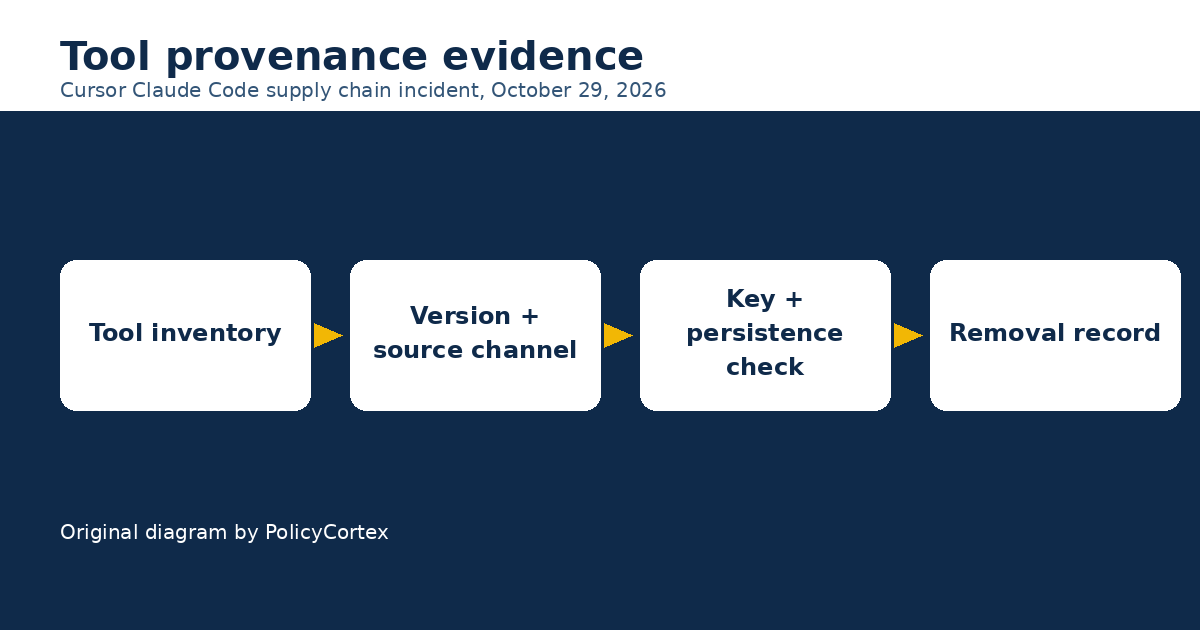
First, the inventory of developer tools on each in scope host. Second, the version and source channel for the Claude Code extension. Third, the check for the svc-telemetry key on each host. Fourth, the check for the LaunchAgent or scheduled task. Fifth, the removal record for any key or persistence found. Sixth, the credential rotation record for affected hosts. A note that says "extension removed" is not enough. Removal of the extension leaves the key and persistence behind. The file must show each artifact checked and cleared.
PolicyCortex does not clean developer hosts. PolicyCortex helps teams link proof to requirements.
Sources
- Cursor security notice, updated October 30, 2026. https://cursor.com/blog/claude-code-extension-security-notice
- The Hacker News article, October 2026. https://thehackernews.com/2026/10/official-claude-code-vs-code-extension.html
- OpenSourceMalware research findings, as quoted by The Hacker News.
- Original diagram by PolicyCortex.
Next step
List each developer tool on in scope hosts, with version and source channel.