Home / Article
GPUStack Auth Bypass: Flaw Remediation Evidence for CMMC
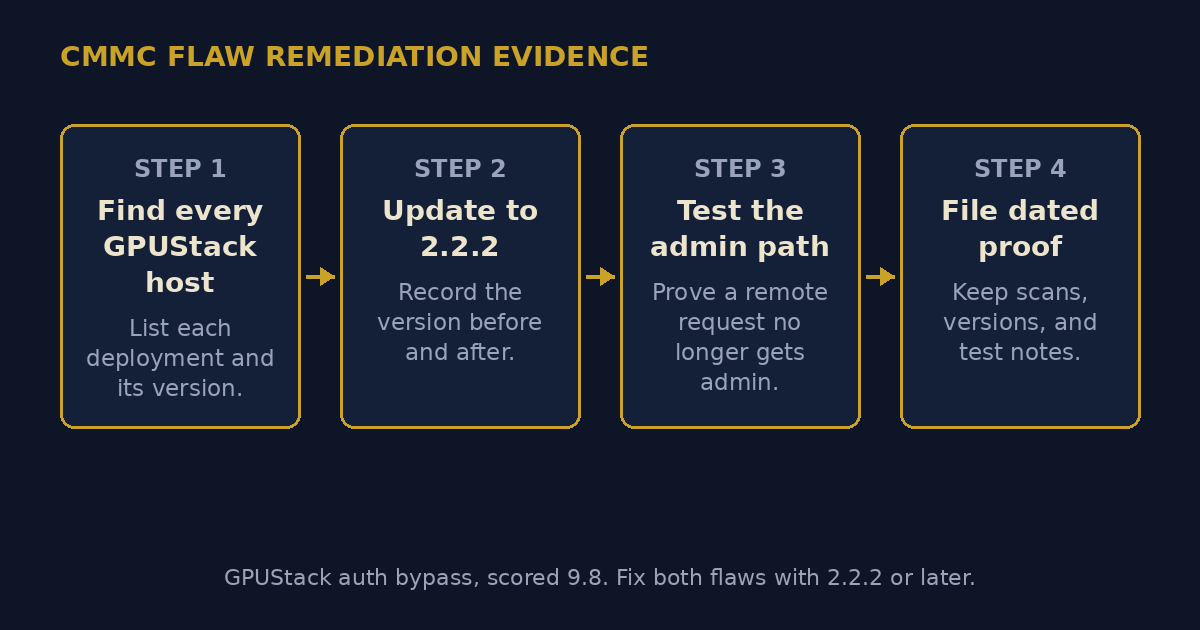
Cybersecurity Maturity Model Certification (CMMC) asks for proof when a flaw appears. GPUStack gave teams a live test of that practice. A login flaw scored 9.8 was already used in attacks. The fix is a version update plus a test.
The flaw in plain words
The record is CVE-2026-102895. Common Vulnerabilities and Exposures (CVE) is the public record system for flaws. GitHub, Inc. assigned the score of 9.8. The score uses Common Vulnerability Scoring System (CVSS) version 3.1. All builds before 2.2.0 are affected. Version 2.2.0 fixed the flaw.
GPUStack is an open source GPU cluster manager. It serves AI models and provisions GPU instances. Its login code treated a loopback request as the built in admin. That trust applied when force_auth_localhost was false. False was the default. A remote request could appear to come from 127.0.0.1. The code accepted a same host reverse proxy peer. It also accepted a client supplied X-GPUStack-Real-IP loopback value. No login was needed to gain admin access.
Admin access meant full control. An attacker could change users and models. An attacker could create a lasting admin API key. An attacker could read worker secrets and cloud provider secrets. An attacker could run code through POST /v2/inference-backends/from-yaml.
The National Vulnerability Database (NVD) record states the key fact. It says, "Exploitation was observed in the wild against a 2.1.1 deployment". SecurityOnline reported on November 5, 2026 that researcher Javier Sixto of ulex.fr reported active attacks. Intruders used custom backends for reverse shells on worker hosts.
What the evidence must show
Practice SI.L2-3.14.1 covers flaw remediation. It asks teams to find flaws and fix them in a timely way. An assessor will want four records for this flaw. First, a dated list of every GPUStack deployment. The list must show the version on each host. Second, the update record for each host. It must show the version before and after. The target is 2.2.2 or later. Third, a test that proves the fix works. Send a remote request with no login. Confirm it no longer gains admin access. Fourth, a hunt for past access. Check for new admin users, new API keys, and new backends. Check worker hosts for odd processes.
A sibling flaw raises the target version. The record is CVE-2026-102894. It scores 9.1. Its SAML callback trusted an unverified SAMLResponse. Security Assertion Markup Language (SAML) is a login standard for single sign on. That flaw allowed auth bypass and account takeover. Version 2.2.2 fixed it. Updating to 2.2.0 alone leaves the second flaw open. Update to 2.2.2 or later instead.
Why this flaw still matters for CMMC
GPUStack may sit outside the core protected system. Its compromise still tests patch discipline. A team that updates fast and hunts for leftovers shows a working process. A team that updates slowly, or skips the hunt, shows a gap. The gap is the finding, even when the tool holds no sensitive data. Evidence closes the gap. A claim alone does not.
Rotate secrets that an attacker could have read. That includes worker secrets and cloud provider secrets. Rotate them even when the hunt finds nothing. Keep the rotation record with the patch proof. An assessor checks dates across all of it.
PolicyCortex does not patch GPUStack. PolicyCortex helps teams link proof to requirements.
Sources
- CVE-2026-102895 record, CVE Program. Auth bypass in GPUStack, fixed in 2.2.0.
- National Vulnerability Database (NVD) record for CVE-2026-102895. Score 9.8 from GitHub as CNA. Exploitation observed in the wild against a 2.1.1 deployment.
- GitHub security advisory GHSA-gj9m-f8ph-pmhr. https://github.com/gpustack/gpustack/security/advisories/GHSA-gj9m-f8ph-pmhr
- GPUStack release 2.2.0. https://github.com/gpustack/gpustack/releases/tag/v2.2.0
- CVE-2026-102894 record, CVE Program. SAML callback flaw, fixed in 2.2.2.
- SecurityOnline coverage, November 5, 2026. It reports active attacks found by researcher Javier Sixto of ulex.fr. Intruders used custom backends for reverse shells on worker hosts.
- Original diagram by PolicyCortex.
Next step
List every GPUStack deployment with its version. Update each one to 2.2.2 or later. File the test proof.