Home / Article
How Do We Collect Evidence for Personnel Security Practices When Staff Work Remotely?
Your staff work from home, but your assessor still wants proof about people. Remote work does not remove the personnel security practices. It changes where the proof lives.
What the practices require
CMMC means Cybersecurity Maturity Model Certification. Level 2 uses the 110 practices from NIST SP 800-171 Revision 2. NIST is the National Institute of Standards and Technology. The personnel security family is section 3.9 of that guide (NIST SP 800-171 Revision 2).
Practice 3.9.1 requires screening of people before they get access to CUI. CUI means Controlled Unclassified Information. Practice 3.9.2 requires protection of CUI during personnel actions. That includes transfers and terminations. The CMMC program rule sits in 32 CFR Part 170. CFR means Code of Federal Regulations (32 CFR Part 170).
A C3PAO checks these practices at Level 2. C3PAO means Certified Third-Party Assessment Organization. It uses the methods in NIST SP 800-171A. Those methods are examine, interview, and test (NIST SP 800-171A).
Screening evidence for remote hires
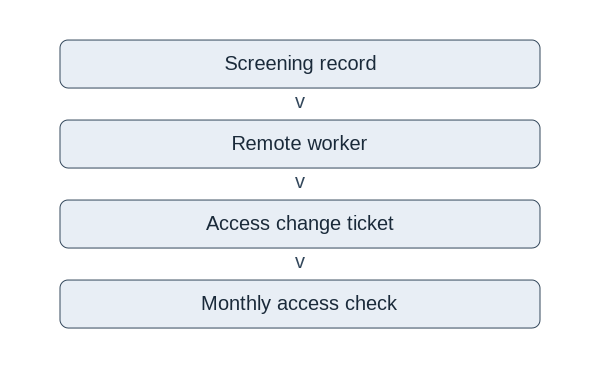
Keep a screening record for each person with CUI access. The record shows what check was done and when. It shows who approved the access. It does not need to hold the full background report. A summary with a date and an approver is enough for most reviews.
File the record where the assessor can find it. Name it with the person and the date. A folder called "screening" with no dates will slow the review down.
Remote hiring adds one risk. You may never meet the person in person. So record how identity was checked at hire. Note the method used and the person who checked it. Keep that note with the screening record.
Evidence for transfers and departures
Personnel actions are where remote teams fail most often. A person changes roles, but old access stays on. A person leaves, but a shared account stays live. The assessor will ask for proof that access changed with the role.
Keep three records for each change. First, the request or notice that started the change. Second, the list of systems and accounts touched. Third, a check that access was removed or changed.
For remote staff, add the device step. Record that company data was removed from the home device. Record that the VPN account was closed. VPN means virtual private network. Record that any shared passwords the person knew were changed.
Do this on the last work day, not weeks later. A dated ticket beats a memory of a phone call.
Interview evidence still matters
Assessors interview people, not just files. They will ask remote staff how they protect CUI at home. They will ask how the person reports a lost laptop. They will ask who they call after a suspicious email.
Prepare staff with short, plain answers. Each person should know three things. They should know where CUI may live. They should know what to do when a device is lost. They should know who to call first.
Record the training that taught those answers. Keep the date, the topic, and the attendance list. A training record with no names proves nothing.
A simple monthly check
Once a month, review the access list against the staff list. Every name on the access list should match a current worker. Every worker with CUI access should have a screening record on file.
Check leavers first. List everyone who left in the last 90 days. Confirm each account is closed. Then check role changes. Confirm access matches the new role, not the old one.
Keep that monthly check as a dated note. Over a year, those notes show a control that stayed in place. One day of proof does not show that.
Next step
PolicyCortex collects evidence from live Azure configuration using 33 collectors. The collectors read conditional access, diagnostic settings, Defender posture, backup, and firewall. The evidence is evaluated against NIST 800-53 and NIST 800-171. It supports re-verification after remediation. It generates SSP, SAR, and POA&M output from collected evidence. SAR means Security Assessment Report. POA&M means Plan of Action and Milestones. PolicyCortex is strongest in commercial Azure, and AWS is covered. Start at https://policycortex.com.
Sources
- NIST SP 800-171 Revision 2, Protecting Controlled Unclassified Information in Nonfederal Systems and Organizations, National Institute of Standards and Technology. https://doi.org/10.6028/NIST.SP.800-171r2
- NIST SP 800-171A Revision 2, Assessing Security Requirements for Controlled Unclassified Information, National Institute of Standards and Technology. https://nvlpubs.nist.gov/nistpubs/SpecialPublications/NIST.SP.800-171a.pdf
- 32 CFR Part 170, Cybersecurity Maturity Model Certification (CMMC) Program, U.S. Department of Defense, eCFR. https://www.ecfr.gov/current/title-32/subtitle-A/chapter-I/subchapter-G/part-170