Home / Article
How Do We Collect Evidence for Risk Assessment Practices Without a Full Risk Team?
Your company has no risk team, but the assessment still asks for risk proof. That gap feels hard to close with two or three people. It is closable with a short list and a steady habit.
Cybersecurity Maturity Model Certification (CMMC) Level 2 includes risk assessment practices. The practices come from NIST Special Publication 800-171 Revision 2. They sit in the risk assessment family, numbered 3.11.
Which practices apply
Practice RA.L2-3.11.1 asks for periodic risk assessments. You must assess risk to your operations, assets, and people. The assessment must cover threats that apply to your systems.
Practice RA.L2-3.11.2 asks for vulnerability scans. You must scan for weak points on a set schedule. You must also scan when new weak points are found.
Practice RA.L2-3.11.3 asks for flaw remediation. You must fix flaws found in scans and reports. You must fix them within the time your plan sets.
These three practices form one chain. Assess the risk, find the weak points, then fix them. An assessor will trace that chain.
Build the risk list with a small team
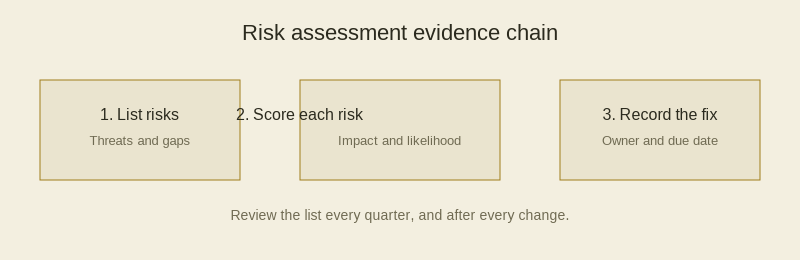
Start with a simple table. Give it five columns: risk, affected system, impact, likelihood, and owner. One row per risk. Keep each row to one plain sentence.
Fill the first rows from sources you already have. Use scan reports, vendor alerts, and past incidents. Use audit findings and staff reports too. Ten to twenty rows is a good start for a small firm.
Score impact from 1 to 3. Score likelihood from 1 to 3. Multiply the two scores for a simple rank. Write the scale down at the top of the table. A written scale keeps scores fair across reviewers.
Turn the list into evidence
Date every version of the list. Save the list where assessors can find it. Note who reviewed it and when. A list with no date proves nothing about timing.
Record one action per high risk item. Name the owner and the due date. When the fix lands, record the closing proof. Closing proof can be a new scan result. It can also be a config export or a ticket closure note.
Keep scan reports beside the list. Save the scan date, the scope, and the tool used. Save the follow up ticket for each finding. An assessor should move from finding to fix without asking for help.
How often to repeat the work
Repeat the risk review at least once per quarter. Repeat it after any major change too. A major change means a new system, a new vendor, or a new site. It also means a serious incident or a new threat alert.
NIST Special Publication 800-171A Revision 2 sets the assessment methods. Assessors examine records, interview staff, and test controls. Your table must match what staff say in interviews. If staff describe a different process, the gap will show.
What to do this week
List your top ten risks in one sitting. Score them with the 1 to 3 scale. Assign an owner and a due date to each one. File the dated list with your other evidence.
Sources
- NIST SP 800-171 Revision 2, National Institute of Standards and Technology.
- NIST SP 800-171A Revision 2, National Institute of Standards and Technology.
- 32 CFR Part 170, Cybersecurity Maturity Model Certification Program, Code of Federal Regulations.
- Original diagram by PolicyCortex.
Next step
Want risk evidence linked to each practice? See how PolicyCortex collects it from live systems.