Home / Article
How Do We Line Up What Our People Say in Interviews With What Our Written Evidence Says?
Your assessor will hear one story in interviews and read another in your files.
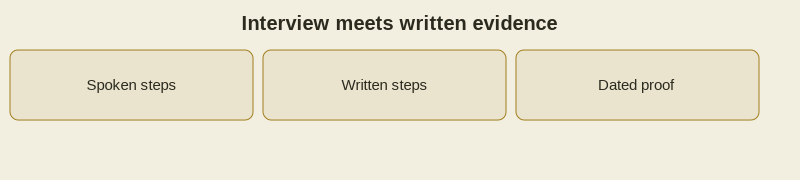
That mismatch is easy to create and hard to explain away. CMMC means Cybersecurity Maturity Model Certification. C3PAO means CMMC Third Party Assessment Organization. A Level 2 assessor uses three methods. Examine means the assessor reads a document. Interview means the assessor talks to a person. Test means the assessor watches a check run. The CMMC Assessment Guide for Level 2 sets out these three methods.
Why the two stories drift apart
Written evidence often describes the ideal process. Staff often describe what they really do each day. Both can be honest. They can still disagree. A policy may say every laptop gets a weekly patch check. A technician may say patch checks run each month. An assessor will notice that gap. The assessor will then ask which version is true.
Drift also comes from updates that stop halfway. A team changes a tool. The procedure still names the old tool. A new hire learns the new way. The written record still shows the old way. Interviews then expose the gap in minutes.
The three checks to run first
First, pick the practices with the most daily action. Access control, patching, and backup are good starts. Read the written procedure for each one. Write down the steps in plain order.
Second, ask the people who do the work to describe each step. Do not show them the procedure first. Let them speak from daily habit. Compare their steps with the written steps. Mark every place where the order, the tool, or the timing differs.
Third, check the dated proof for each step. A log, a ticket, or a report should match the spoken step. If staff say checks run weekly, the logs should show weekly runs. If the logs show monthly runs, the spoken answer and the log disagree. Fix the process or fix the record. Never fix only the answer.
How to prepare staff without scripting them
Do not hand staff a script to memorize. Assessors can tell when answers sound rehearsed. A rehearsed answer also breaks when the assessor asks a follow up question. Instead, give staff the real procedure to read. Let them ask questions about parts that do not match daily work. Update the procedure where daily work is right. Change daily work where the procedure is right.
Teach staff three habits for interview day. Answer only what they know from their own work. Say "I do not know" when that is true. Point to the record that proves their answer. Those habits build trust. They also keep small gaps small.
What to do when you find a mismatch
Start with the smallest fix that makes both stories true. If the tool changed, update the procedure and the evidence index. If the timing changed, update the schedule and the logs. If staff skip a step, find out why the step is skipped. A step that no one follows may be unclear, slow, or out of date.
Record the fix with a date. Keep the old version in your file. An assessor may ask why a document changed. A dated change note answers that question at once. It also shows that your process can correct itself.
A short dry run you can repeat
Choose five practices. For each one, read the procedure, interview the owner, and pull one dated record. Note every mismatch in one list. Fix the list before the assessment. Repeat the dry run after each fix. When interviews, documents, and logs agree, your evidence is ready to stand up to questions.
Sources
- CMMC Assessment Guide, Level 2.
- NIST SP 800-171 Revision 2.
- NIST SP 800-171A.
- Original diagram by PolicyCortex.
Next step
Want evidence tied to each practice from live systems? See how PolicyCortex collects it.