Home / Article
How Does Evidence Feed Our System Security Plan?
Your evidence folder is full, but your plan still reads like a draft.
CMMC means Cybersecurity Maturity Model Certification. SSP means System Security Plan. CUI means Controlled Unclassified Information. C3PAO means CMMC Third-Party Assessment Organization. NIST means National Institute of Standards and Technology.
Start with the plan, not the folder
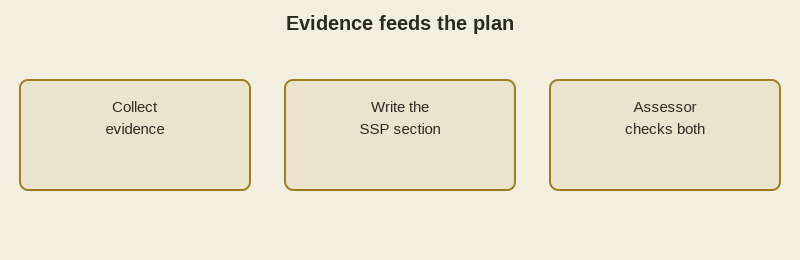
Your SSP is the claim. Your evidence is the proof. When the two disagree, the assessor trusts the proof.
Requirement 3.12.4 in NIST SP 800-171 Revision 2 sets this rule. The SSP must describe the boundary and the operating environment. It must show how you meet each security requirement. It must show links to other systems.
Write each SSP section from evidence, not from memory. State the safeguard in plain words. Name the system that enforces it. Name the record that proves it works.
Build one evidence line per safeguard
Use the same line for every safeguard. It keeps the plan short and easy to check.
First, write the safeguard in one sentence. Second, name the owner who runs it. Third, name the evidence that proves it. Fourth, give the date of the newest record.
A weak line says access is controlled. A strong line says only named staff can open the CUI folder. It names the group that holds access. It cites the dated permission export. It cites the last access review.
If you cannot name the record, you do not have the safeguard yet. Write the gap in the plan. Track it in a POA&M. POA&M means Plan of Action and Milestones.
Keep the boundary evidence current
The boundary is where CUI can flow. Assessors check it before they check anything else. The CMMC assessment guide lists boundary checks for the SSP (CMMC Assessment Guide, Level 2).
Update the boundary when the network changes. Add new systems to the diagram. Remove retired systems from the list. Date every change in the plan.
Old evidence hurts you here. A diagram from last year does not match a network from this year. Collect a fresh diagram before the assessment. Match each system on the diagram to a line in the SSP.
Use live settings, not old screenshots
A screenshot proves a setting on one day. A system export proves it with more detail. The assessor can test the live system too.
NIST SP 800-171A describes three assessment methods (NIST SP 800-171A). Examine means reading your documents. Interview means asking your staff. Test means checking the live system.
Match the SSP claim to the live setting. Check access settings first. Check audit settings next. Check backup settings last. If a setting changed, update the SSP line and the evidence date together.
Close the loop after each fix
A fix without new evidence is only a promise. Re-collect the record after the fix. Update the SSP section with the new date. Close the POA&M item only then.
Keep old versions of the SSP. An assessor may ask what the plan said last quarter. A dated version answers that question fast. A single overwritten file does not.
Next step
PolicyCortex collects evidence from live Azure configuration with 33 collectors. The collectors read conditional access, diagnostic settings, Defender posture, backup, and firewall. The evidence is evaluated against NIST 800-53 and NIST 800-171. That evidence supports re-verification after remediation. SAR means Security Assessment Report. It generates SSP, SAR, and POA&M output from collected evidence. AWS means Amazon Web Services. PolicyCortex is strongest in commercial Azure, and AWS is covered. Start at policycortex.com.
Sources
- NIST SP 800-171 Revision 2, Protecting Controlled Unclassified Information in Nonfederal Systems and Organizations. https://doi.org/10.6028/NIST.SP.800-171r2
- NIST SP 800-171A Revision 2, Assessing Security Requirements for Controlled Unclassified Information. https://doi.org/10.6028/NIST.SP.800-171a
- CMMC Assessment Guide, Level 2, Version 2.0, United States Department of Defense. https://dodcio.defense.gov/portals/0/documents/cmmc/ag_level2_masterv2.0_final_202112016_508.pdf
- 32 CFR Part 170, Cybersecurity Maturity Model Certification Program. https://www.ecfr.gov/current/title-32/subtitle-A/chapter-I/subchapter-G/part-170
- Diagram: original by blog.cmmcevidence.com.