Home / Article
Eight 10.0 Aruba Flaws Test Your CMMC Flaw Remediation Evidence
Cybersecurity Maturity Model Certification (CMMC) does not grade intentions. It grades records. HPE's ArubaOS bulletin is a fresh test of yours.
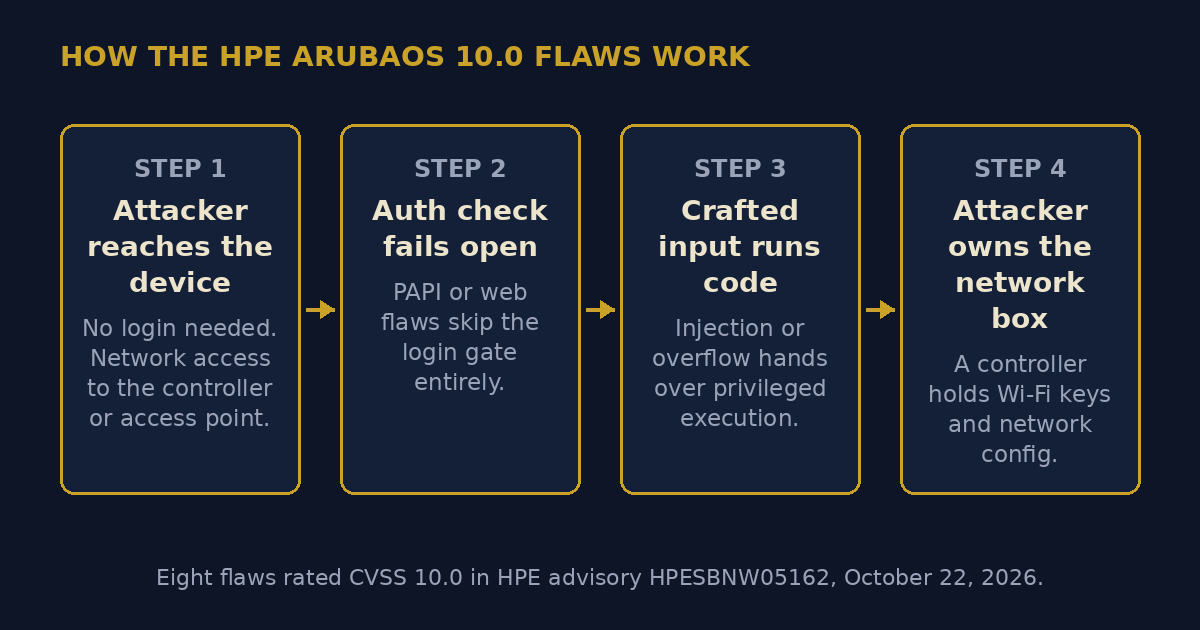
On October 22, 2026, HPE Networking published advisory HPESBNW05162. It fixes 72 flaws in ArubaOS 8 and 10. HPE rates eight at CVSS 3.1 10.0. Seven resolve to HPE records. One ID needs a note. The Common Vulnerability Scoring System (CVSS) rates severity from 0 to 10. A 10.0 is the maximum.
The eight listed flaws
Common Vulnerabilities and Exposures (CVE) is the public record system.
- CVE-2026-79844: AOS-10 authentication bypass to command execution.
- CVE-2026-79845: AOS-10 PAPI protocol authentication bypass to admin access. HPE lists it at 10.0. Its public CVE record names another product, so this article links it to the HPE advisory instead.
- CVE-2026-79847 and CVE-2026-79851: AOS-10 buffer overflows to remote code execution.
- CVE-2026-79846: AOS-8 command injection.
- CVE-2026-79848 and CVE-2026-79849: AOS-8 SQL injections to command execution.
- CVE-2026-79850: AOS-8 authentication bypass to root commands.
Each needs network access only. No login is needed. No user must act.
One ID needs care
HPE lists CVE-2026-79845 at 10.0 for the PAPI flaw. The public CVE record for that ID names a different product. It scores 7.3, not 10.0. Count seven verified 10.0 IDs until the record is fixed.
What the assessor will ask
Practice SI.L2-3.14.1 covers flaw correction in time. It asks for four things per flaw: identification, timing, fix, and proof.
Start with the inventory. List every Aruba controller, gateway, and access point. Record the build on each. The fixed builds are AOS-10 10.8.1.2, 10.7.2.7, and 10.4.1.14, and AOS-8 8.13.3.1 and 8.10.0.24.
Next, record the upgrade date per device. Then keep the re-scan that shows the flaws are gone. A patch ticket without a re-scan is a claim, not evidence.
Asset practice CM.L2-3.4.1 also applies. Network boxes are assets. If your inventory omits them, the flaw file has nothing to attach to.
HPE reported on October 22, 2026 that it knew of no public exploit code. It also knew of no exploitation in the wild. No eight ID is in the CISA Known Exploited Vulnerabilities catalog as checked on October 25, 2026. Patch while that is still true.
Sources
- HPE Networking security advisory HPESBNW05162, Multiple Vulnerabilities in HPE Networking Wireless Operating Systems (AOS-10 and AOS-8), October 22, 2026.
- CVE-2026-79844 record, CVE Program.
- The PAPI flaw listed as CVE-2026-79845 is sourced to the HPE advisory above. Its public CVE record currently names another product.
- CVE-2026-79846 record, CVE Program.
- CVE-2026-79847 record, CVE Program.
- CVE-2026-79848 record, CVE Program.
- CVE-2026-79849 record, CVE Program.
- CVE-2026-79850 record, CVE Program.
- CVE-2026-79851 record, CVE Program.
- Original diagram by PolicyCortex.
Next step
Want flaw and asset evidence linked to each practice? See how PolicyCortex collects it from live systems.