Home / Article
UpdraftCentral and the CMMC Supply Chain Lesson
CMMC expects contractors to manage supply chain risk. This week showed why that practice is not paperwork.
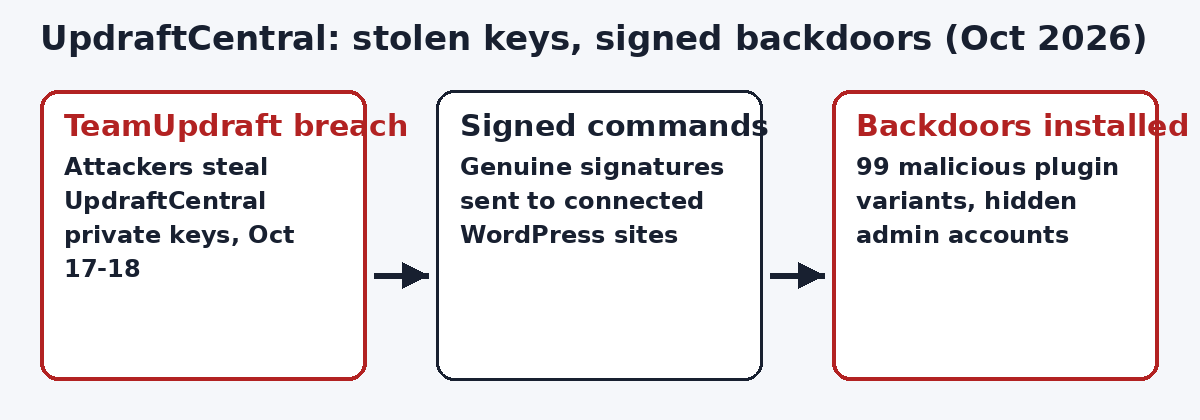
Over the weekend of October 17 and 18, 2026, attackers broke into TeamUpdraft's website. TeamUpdraft makes UpdraftPlus, the most popular WordPress backup plugin, with more than four million active installations. The attackers took the customer database and the private keys behind UpdraftCentral, its remote site management service.
Then they used those keys as designed. They sent commands to connected WordPress sites. The commands installed backdoor plugins. Every check on the sites passed because the signatures were real.
What the researchers saw
Security firm Nethemba found the campaign on its own servers and published the first detailed analysis on October 19. Security firm Patchstack watched signed commands install 99 different malicious plugin names between 15:32 UTC on October 18 and 09:23 UTC on October 19. Patchstack rates the impact at 9.8 on the Common Vulnerability Scoring System (CVSS) scale.
There is no CVE for this. No plugin flaw was exploited. Patching the plugin does not stop it.
The CMMC angle
The CMMC supply chain practices ask contractors to identify and manage risks from suppliers and the products they deliver. A vendor that holds signing keys over your systems is a supplier risk, not just a software choice.
The incident response practices ask contractors to handle incidents when they happen. Your evidence should show three things for this one.
First, the inventory: which of your systems held a live UpdraftCentral key. Second, the compromise check: unknown plugins, unknown admin accounts, unknown login cookies. Third, the remediation: the update applied, the keys rotated, the manual deletions done.
The key date trap
TeamUpdraft shipped UpdraftPlus 1.26.12 to revoke the old keys. Nethemba's code review found it did not delete them. Versions 1.26.13 and 2.26.13 remove keys created before 12:07 UTC on October 18.
Keys created between 12:07 and 21:00 UTC that day survive the update. They must be deleted by hand. A remediation record that says "we updated the plugin" is incomplete without the manual deletion check.
What to do this week
Search your sites for plugins you did not install. Check the admin list for accounts you did not create. Update to UpdraftPlus 1.26.13 or Premium 2.26.13.
Then check your key dates against the 12:07 to 21:00 UTC window on October 18. Delete any key in that window by hand. Record every step.
Sources
- Security incident disclosure, TeamUpdraft, October 19, 2026. Vendor's primary incident statement.
- "Stolen UpdraftCentral Keys Are Backdooring WordPress Sites," Patchstack, October 19, 2026. https://patchstack.com/articles/updraftcentral-key-compromise-wordpress-backdoors/
- Campaign analysis, Nethemba, October 19, 2026. First detailed researcher analysis of the campaign.
- CMMC Model, Risk Management and Incident Response domains. https://dodcio.defense.gov/cmmc/
- Original diagram by PolicyCortex.
Next step
Want vendor-held access mapped across your estate on a schedule? See how PolicyCortex collects the evidence.