Home / Article
What Do Assessors Test in a Practice, and How Do We Record the Test So It Counts?
Your assessor will not take your word that a control works. They will ask to see it run.
CMMC means Cybersecurity Maturity Model Certification. C3PAO means CMMC Third Party Assessment Organization. A Level 2 assessor checks each practice with three methods. Examine means the assessor reads a document. Interview means the assessor talks to a person. Test means the assessor watches a check run, or reviews proof that it ran. The CMMC Assessment Guide for Level 2 sets out these three methods.
What a test looks like
A test proves a control works on a real system. It is not a policy statement. It is not a plan for later. It is a dated action with a clear result.
Here are plain examples. Try to log in without a second factor, and record that access was denied. Run a patch report, and record the date and the missing patches. Restore one test file from backup, and record that the restore worked. Each example shows the control in action.
A test can also be a tool output. A scan report with a date counts. A log export with a date counts. A screen recording of a check counts. What matters is the proof, not the format.
The four facts every test record needs
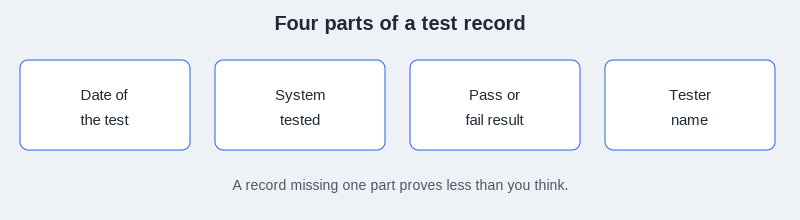
First, the date the test ran. A record with no date proves nothing about timing. Second, the system that was tested. Name the system, not just the company. Third, the result. Say pass or fail in plain words. Fourth, the person who ran the test. Name the tester and their role.
Add one more fact when you can. Add the practice the test supports. Link the record to that practice in your evidence index. An assessor should reach the record from the practice in one step.
What fails, even when the control works
A screenshot with no date fails. A report for a different system fails. A pass mark with no tester name fails. A test run once, with no repeat, may fail for a control that must run all year.
Fix these gaps before the assessment. Date every record. Name every system. Name every tester. Keep the raw output, not just a summary slide. A summary can hide a fail. Raw output cannot.
How to run a test dry run
Pick five practices from your scope. For each one, find the test record. Check for the four facts above. Check that the link in your evidence index opens the right file. If a record is missing, run the test now and file the result.
Do this dry run one month before the assessment. That leaves time to fix gaps. It also leaves time to rerun a test that failed. A failed test, fixed and retested, is strong evidence. A failed test, hidden, is a finding.
Sources
- CMMC Assessment Guide, Level 2.
- NIST SP 800-171 Revision 2.
- NIST SP 800-171A.
- Original diagram by PolicyCortex.
Next step
Want evidence tied to each practice from live systems? See how PolicyCortex collects it.