Home / Article
What Evidence Gaps Delay CMMC Assessments Most?
Your assessor pauses the schedule on day two. A key record is missing. Nobody on the interview list can answer the question. You lose a week.
CMMC means Cybersecurity Maturity Model Certification. CUI means Controlled Unclassified Information. A C3PAO is a CMMC Third-Party Assessment Organization, the accredited body that runs Level 2 certification assessments.
Know how the assessor grades you
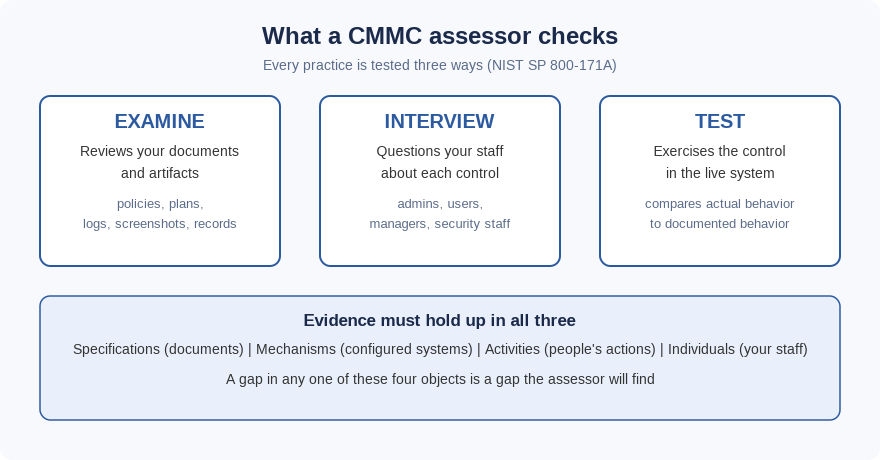
Assessors test every practice three ways: examine, interview, and test. The method comes from NIST Special Publication 800-171A (SP 800-171A), the assessment guide for 800-171 requirements. NIST is the National Institute of Standards and Technology. Examine means reviewing your documents and artifacts. Interview means questioning your staff about each control. Test means exercising the control in the live system (NIST SP 800-171A).
Assessment objects are specifications, mechanisms, activities, and individuals. Specifications are your documents: policies, procedures, and plans. Mechanisms are your configured systems: hardware, software, and firmware. Activities are your people's actions, like monitoring traffic or running backups. Individuals are the staff who do the work. A gap in any one of these is a gap the assessor will find.
Gap 1: a stale System Security Plan
The System Security Plan, or SSP, is the first thing assessors examine. The assessment guide lists eight checks for the SSP alone (CMMC Assessment Guide, Level 2). They cover the system boundary, the operating environment, and how each requirement is implemented. They also cover connections to other systems and a defined update schedule.
If your network changed since the SSP was written, fix the SSP first. A stale SSP creates risk across the whole assessment. Update it on the schedule your own SSP defines.
Gap 2: the CUI boundary is never drawn
Assessors examine where CUI can flow before they test anything else. That means a current data flow diagram and an asset list tied to it. Without the diagram, assessors cannot confirm the scope of the assessment. Re-scoping mid-assessment adds days and sometimes unassessed systems.
Draw the boundary before you collect anything else. Include every system that stores, processes, or transmits CUI. Review the diagram with the person who runs the network.
Gap 3: policies with no procedures behind them
Most companies have a security policy for each domain. Fewer have written procedures that say who does what and when. Assessors examine both. A policy states the rule. A procedure shows the routine.
Write one page per control: the steps, the owner, and the frequency. Tie each procedure to the policy and the practice it supports.
Gap 4: no records of ongoing activity
Activities need proof, not promises. Audit log reviews, training completions, access reviews, and backup runs all need dated records. 800-171A lists records among the artifacts assessors are given, alongside policies, procedures, and plans (NIST SP 800-171A).
Collect the records on the schedule your procedures define. After the assessment, keep the hashed artifacts for six years. That retention period comes from the program rule (32 CFR Part 170). CFR is the Code of Federal Regulations.
Gap 5: the live system disagrees with the documents
Test means the assessor checks the live system against your documents. Screenshots from January mean nothing if the setting changed in March. Re-collect configuration evidence in the week before the assessment. Match every exported setting to the value your SSP claims.
Pay special attention to access control and audit settings. They draw the most scrutiny because they guard CUI directly.
Gap 6: inherited controls with no paper trail
If a vendor or cloud service covers part of a control, document it. Keep the responsibility matrix, the vendor agreement, and the provider's evidence for their share. 800-171A lists information exchange agreements and legal requirements among the artifacts assessors review (NIST SP 800-171A). A control you cannot trace to a responsible party is a control you cannot prove.
Gap 7: nobody ready for the interview
Individuals are assessment objects too. Assessors interview administrators, managers, security staff, and regular users. Each one must describe their part of the controls in their own words. Run a mock interview for every role on the interview list. Fifteen minutes per person is enough to find the gaps.
Close the gaps in this order
Work in this order. Draw the boundary and refresh the SSP first. Then write the procedures and collect the activity records. Re-check live settings against the documents next. Document inherited controls and rehearse interviews last. Assessors examine documents first, so the documents go first.
Next step
PolicyCortex collects evidence from live Azure configuration using 33 collectors. The collectors read conditional access, diagnostic settings, Defender posture, backup, and firewall. The evidence is evaluated against NIST 800-53 and NIST 800-171. It supports re-verification after remediation. It generates SSP, SAR, and POA&M output from collected evidence. SAR means Security Assessment Report. POA&M means Plan of Action and Milestones. PolicyCortex is strongest in commercial Azure, and AWS is covered. Start at policycortex.com.
Sources
- NIST SP 800-171A Rev. 2, Assessing Security Requirements for Controlled Unclassified Information, National Institute of Standards and Technology. https://doi.org/10.6028/NIST.SP.800-171a
- NIST SP 800-171A Rev. 3, Assessing CUI Requirements, National Institute of Standards and Technology. https://nvlpubs.nist.gov/nistpubs/SpecialPublications/800-171Ar3/NIST.SP.800-171Ar3.html
- CMMC Assessment Guide, Level 2, Version 2.0, U.S. Department of Defense, Chief Information Officer. https://dodcio.defense.gov/portals/0/documents/cmmc/ag_level2_masterv2.0_final_202112016_508.pdf
- 32 CFR Part 170, Cybersecurity Maturity Model Certification (CMMC) Program, U.S. Department of Defense. https://www.ecfr.gov/current/title-32/subtitle-A/chapter-I/subchapter-G/part-170
- Diagram: original by blog.cmmcevidence.com.