Home / Article
What Evidence Supports System Integrity Practices for Patching and Flaw Fixes?
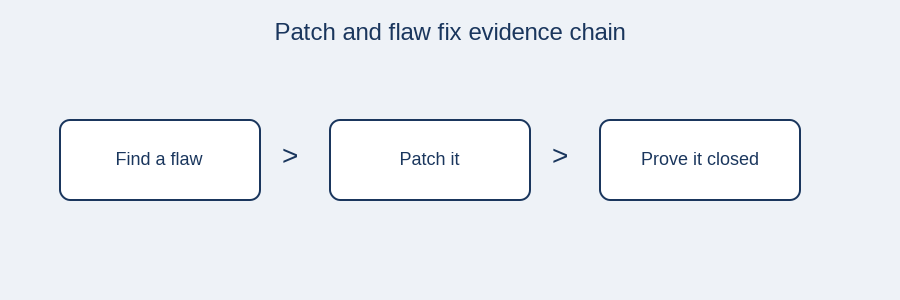
A patch ticket with no closing proof leaves an assessor guessing. The fix may be real. The proof is still missing.
Cybersecurity Maturity Model Certification (CMMC) Level 2 tests proof, not intent. System integrity practices cover flaws, malicious code, and alerts. This article covers the evidence for each part.
Which practices apply
Practice SI.L2-3.14.1 covers flaw remediation. You must identify, report, and correct flaws in time. The practice comes from NIST Special Publication 800-171 Revision 2.
Practice SI.L2-3.14.2 covers malicious code protection. You must run protection tools at set points in the system. Those points include entry and exit points for data.
Practice SI.L2-3.14.3 covers security alerts. You must monitor alerts and advisories for your systems. You must act on alerts that apply to you.
Practice SI.L2-3.14.4 covers updates to that protection. You must update malicious code tools when vendors release updates. An old tool version is weak evidence.
The evidence pack for one flaw
Start with the flaw record itself. Save the scan report or vendor advisory that found it. Record the date found and each affected system.
Next, save the patch ticket with its full history. The ticket should show who owned the fix. It should show the planned date and the actual date.
Then save proof the fix landed. A post patch scan is strong proof. A version check on the patched system also works. A reboot log helps when a patch needs a restart.
Close the loop with a check for harm. Save the log review that looked for prior abuse. Note the result even when the review finds nothing. A blank gap invites questions later.
Evidence for malicious code protection
Show where protection tools run in your system. A simple inventory lists each system and its tool. It also lists the tool version on each system.
Show that updates reach those tools on schedule. Save update logs for a sample of systems. Pick systems from each part of your boundary.
Show that alerts reach a person who acts. Save one alert and the ticket it created. That pair proves the chain works in real life.
What assessors test, not just read
Assessors use examine, interview, and test methods. Those methods come from NIST Special Publication 800-171A. Examine means they read your records. Interview means they ask your staff how the work happens. Test means they check the control in action.
Expect them to pick a flaw at random. They will trace it from discovery to closure. A clean trace beats a thick binder every time.
Expect them to ask about flaws you could not fix on time. Have an answer ready for each one. Show the risk note and the interim control. Show the planned fix date and the owner.
What to do this week
Pick five recent flaws from your scan reports. Trace each one from discovery to closure. Fix any trace that stops before proof of closure.
Sources
- NIST SP 800-171 Revision 2, National Institute of Standards and Technology.
- NIST SP 800-171A Revision 2, National Institute of Standards and Technology.
- 32 CFR Part 170, Cybersecurity Maturity Model Certification Program, Code of Federal Regulations.
- Original diagram by PolicyCortex.
Next step
Want patch and flaw evidence linked to each practice? See how PolicyCortex collects it from live systems.