Home / Article
What Goes in an Evidence Index That the C3PAO Actually Wants to Read First?
Your assessor opens your evidence index before anything else. If the index is vague, the assessment starts slow. If it is clear, the assessor trusts the rest of your work.
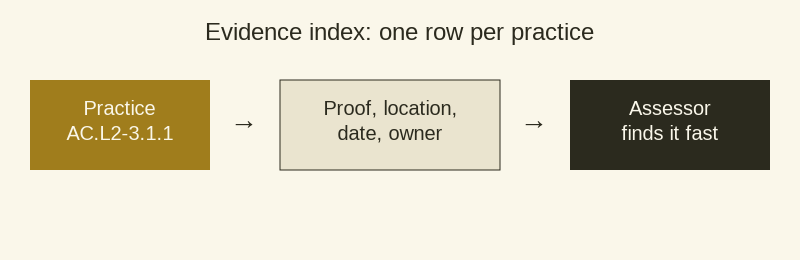
CMMC means Cybersecurity Maturity Model Certification. C3PAO means CMMC Third-Party Assessment Organization. An evidence index is a list that maps each practice to its proof. It also gives the location, date, and owner of each proof.
What the index must contain
Each row of the index needs five facts. First, the practice number and name. Second, a short title for the proof. Third, the exact location of the proof. Fourth, the date the proof was collected. Fifth, the name of the person who owns it.
A location must be exact. A folder name alone is not enough. Give the file name and the path. If the proof lives in a tool, name the tool and the report. An assessor should reach each proof in under a minute.
How to order the rows
Order rows by practice number, not by date collected. Assessors work through practices in order. They check one practice, then move to the next. An index ordered by date forces them to hunt. An index ordered by practice lets them move fast.
Group rows under each practice when one practice has several proofs. Label each proof as examine, interview, or test. Examine means a document the assessor reads. Interview means a person the assessor talks to. Test means a check the assessor watches or reruns. The CMMC Assessment Guide uses these three methods.
What a strong row looks like
A weak row says "access policy, shared drive." A strong row says more. It names the practice, the file, the path, the date, and the owner. For example, a strong row for access control names the policy file, its path, the approval date, and the owner. The assessor opens it at once. No follow-up question is needed.
Add a status column for gaps. Mark each row as complete, partial, or missing. Do not hide a missing proof. A missing row with a plan beats a gap the assessor finds alone. Link each missing row to your Plan of Action and Milestones. POA&M means Plan of Action and Milestones.
What to leave out
Leave out marketing text and background essays. The index is a map, not a report. Leave out proofs that do not match the practice. One wrong link costs more trust than one missing link. Leave out draft files unless you label them as drafts. A draft shown as final proof will fail the practice.
How to keep it current
Update the index each time you collect new proof. Update it when a file moves. Update it when an owner changes roles. Check the whole index one month before the assessment. Open every link in it. Fix every broken path. Print it for the opening meeting. The assessor reads it first, so make it the best document you own.
Sources
- CMMC Assessment Guide, Level 2.
- NIST SP 800-171 Revision 2.
- Original diagram by PolicyCortex.
Next step
Want evidence tied to each practice from live systems? See how PolicyCortex collects it.