Home / Article
What Do We Do When an Assessor Says a Piece of Evidence Does Not Satisfy the Practice?
Your assessor just told you that a file does not prove a practice. That moment feels like a fail, but it is usually a gap in proof, not a gap in work. Stay calm, ask what is missing, and fix the proof.
Ask what the assessor tested
CMMC means Cybersecurity Maturity Model Certification. Level 2 uses the 110 practices from NIST SP 800-171 Revision 2. NIST means National Institute of Standards and Technology. A C3PAO assesses those practices at Level 2. C3PAO means Certified Third-Party Assessment Organization.
An assessor uses three methods from NIST SP 800-171A. Those methods are examine, interview, and test (NIST SP 800-171A). Examine means reading a document or record. Interview means asking a person how work is done. Test means watching a control work in real life.
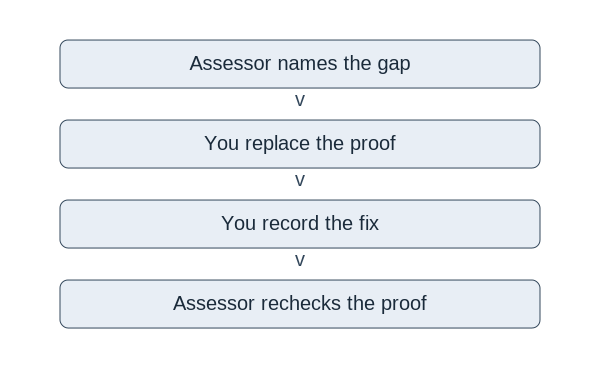
Ask which method found the gap. Ask which assessment objective was not met. An objective is the specific check inside a practice. A practice can have several objectives, and only one may be weak. That answer tells you exactly what to fix.
Do not argue the file, replace the proof
Do not defend the rejected file. Ask what stronger proof would look like. A policy alone rarely proves a practice. A record that shows the policy in use proves far more.
For example, a password policy does not prove access control. A list of accounts with review dates does. A training policy does not prove training happened. An attendance list with dates does.
If the assessor wants a test, offer a live demo. Show the control working on a real system. Record the date, the system, and the person who ran the test. That record becomes the new evidence.
Check four common gaps first
First, check scope. The evidence may cover the wrong system. The assessor needs proof for the system that holds CUI. CUI means Controlled Unclassified Information. A company wide file does not prove a system specific control.
Second, check dates. Evidence from last year may be too old. The assessor needs proof that the control works now. A fresh record beats an old policy every time.
Third, check names and owners. A file with no owner looks unfinished. Name the person who owns the control. Name the person who checked the record.
Fourth, check the link to the practice. The assessor must trace each file to one practice. If the link is unclear, add a short note. State what the file proves and which objective it covers.
Record the gap and the fix
Write the gap down the same day. Note the practice, the objective, and what the assessor asked for. Note the person who will fix it and the date it is due.
If the practice is not yet met, add it to your POA&M. POA&M means Plan of Action and Milestones. A POA&M lists each open item, its owner, and its due date. It shows the assessor that the gap is tracked, not ignored.
Keep the old file too. Do not delete rejected evidence. File the new proof beside it, with a note that explains the change. That trail shows learning, not hiding.
Ask for a recheck before you move on
Once the new proof is ready, ask the assessor to recheck it. Do this while the assessment is still open, when you can. A quick recheck avoids a surprise at the end.
If the assessor still disagrees, ask for the reason in writing. A written reason helps you fix the right thing. It also helps the next person who owns that control.
A rejected file is not the end of your assessment. It is a clear instruction on what proof is missing. Answer that instruction with a better record, and move on.
Next step
PolicyCortex collects evidence from live Azure configuration using 33 collectors. The collectors read conditional access, diagnostic settings, Defender posture, backup, and firewall. The evidence is evaluated against NIST 800-53 and NIST 800-171. It supports re-verification after remediation. It generates SSP, SAR, and POA&M output from collected evidence. SAR means Security Assessment Report. SSP means System Security Plan. PolicyCortex is strongest in commercial Azure, and AWS is covered. Start at https://policycortex.com.
Sources
- NIST SP 800-171 Revision 2, Protecting Controlled Unclassified Information in Nonfederal Systems and Organizations, National Institute of Standards and Technology. https://doi.org/10.6028/NIST.SP.800-171r2
- NIST SP 800-171A Revision 2, Assessing Security Requirements for Controlled Unclassified Information, National Institute of Standards and Technology. https://nvlpubs.nist.gov/nistpubs/SpecialPublications/NIST.SP.800-171a.pdf
- 32 CFR Part 170, Cybersecurity Maturity Model Certification (CMMC) Program, U.S. Department of Defense, eCFR. https://www.ecfr.gov/current/title-32/subtitle-A/chapter-I/subchapter-G/part-170